Product:
Feature improvement
Project duration:
2 weeks
Teams involved:
Product, UX, Data, Engineering
Role:
Product Manager
Flash Sale Management System - Feature Improvement
Background & context
eCommerce ABC is a dynamic marketplace that streamlines the supply chain by connecting first-hand suppliers directly to the market through a dual-model approach. For individual consumers (B2C), the platform provides direct access to high-quality products at wholesale prices, making smart shopping accessible to everyone. Simultaneously, it serves as a robust B2B engine, empowering thousands of local entrepreneurs and SMEs through an integrated dropshipping and reseller ecosystem that allows them to scale their businesses with minimal inventory risk.
Currently, Flash Sale management at eCommerce ABC relies on a manual, high-touch process. The Marketing team prepares a specific Excel file for each schedule, containing 6 SKUs, discount percentages, and flash sale quantities. This file is then handed over to the Engineering team, who must manually "parse" and upload the data to the database to ensure it appears on the dashboard.
The goal of my proposed is to publish scheduled products list in the Flash Sale section on the Dashboard, without any friction.
Key insights & problem analysis
These problems scale poorly as Flash Sale frequency increases:
Operational Handoff
The core inefficiency is not the tool (Excel) itself, but the mandatory manual handoff
between teams for every schedule. Transitioning to other static documents (Google Sheets,
Google Docs, Notion, etc.) would not solve the root cause, as the dependency on Engineering
to "translate" data into the dashboard remains.Constant Dependency
While manual handoffs create unnecessary waiting times, Marketing must wait for a
developer to be available to execute any changes, making the process of finalizing a Flash
Sale schedule slow and inflexible.Midnight Deployment Risk
Since Flash Sale schedules often rotate at midnight, 7 days a week, the manual process
necessitates real-time coordination outside of regular working hours. This increases the risk
of delayed publishing if a developer is unavailable.Lack of System Validation
Inputting data via Excel offers zero real-time validation against the live product catalog or
warehouse stock. This high-risk process is prone to human error (typos in SKUs or pricing),
which can lead to significant financial loss or a poor customer experience if incorrect data
goes live.
Proposed solution
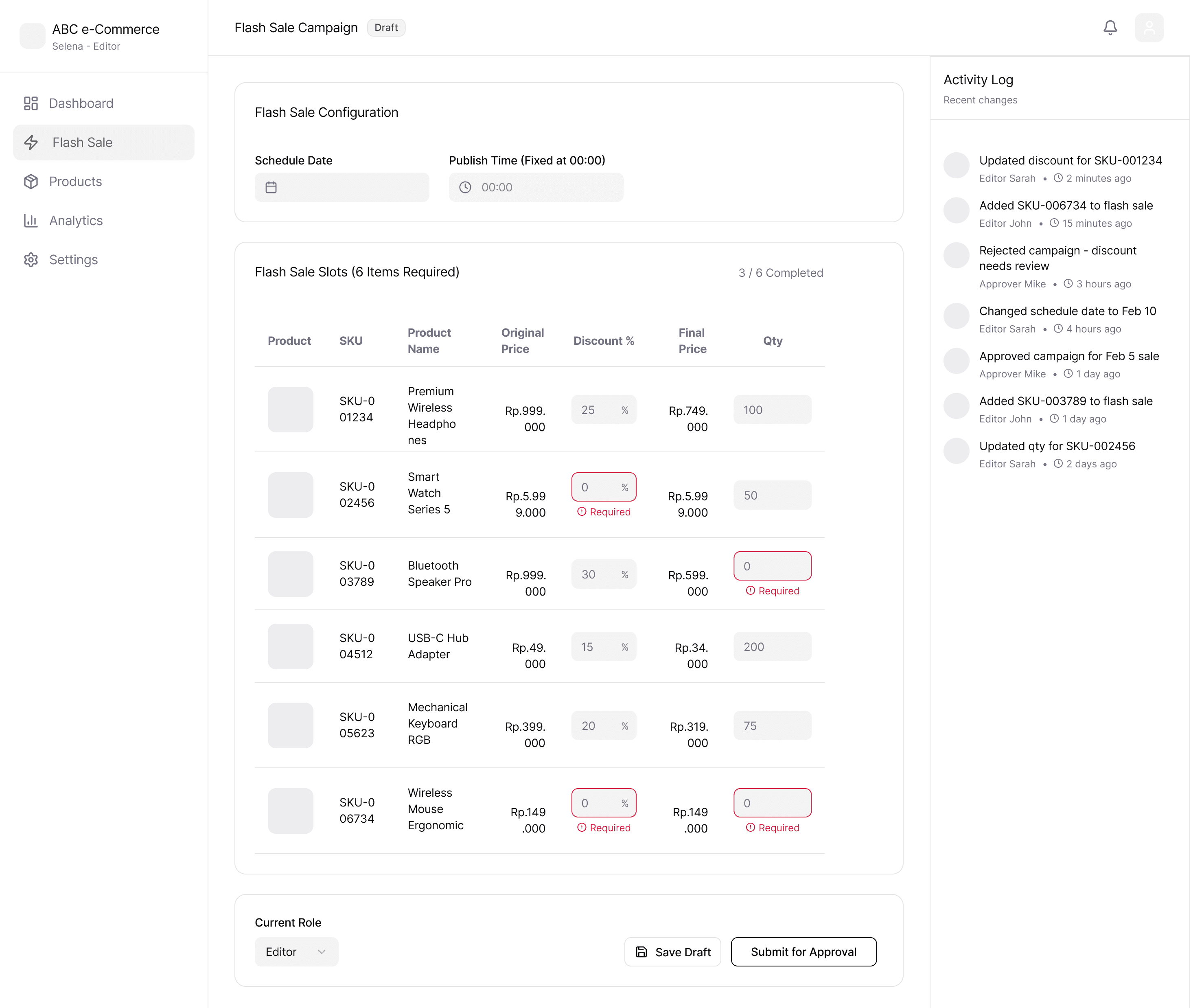
I designed and implemented an automated Flash Sale Management System to streamline the end-to-end promotional display process. By allowing the Marketing team to auto-populate data directly into the dashboard, the system significantly reduces engineering dependency and manual intervention. This transformation enables the business to execute time-sensitive promotions faster while maintaining a centralized and efficient internal workflow.
The system utilizes a structured, role-based hierarchy (Editor and Approver) to ensure data integrity and eliminate human error. Editors are responsible for assigning exactly six SKUs per session with built-in discount guardrails (1%–90%), while Approvers verify and lock the data into a read-only state. This entire lifecycle—from Draft to Live—is tracked through automated status transitions and comprehensive activity logs, providing full transparency and auditability for every promotion.
To mitigate operational risks, the solution features robust concurrency controls to prevent conflicting edits and real-time validation to ensure only valid catalog SKUs are used. I also integrated an intelligent reminder system to alert users as publishing deadlines approach, followed by a fully automated publishing trigger. The result is a secure, "set-and-forget" ecosystem that upholds strict business rules without requiring developer involvement for every flash sale event.